The Strivewell Journal
New Year, New Dietary Guidelines for Americans
By Julie Riney, Strivewell Founder and Coach
Every five years, the USDA releases updated Dietary Guidelines intended to shape nutrition policy, public health messaging, and the way Americans think about food. As a health coach, I’m familiar with the role these guidelines play, but I’m also aware that they’re developed within a system influenced by industry, politics, and feasibility, not just pure science.
Because of that, I treat the Dietary Guidelines as one reference point, not a rulebook. When I guide clients, I lean more heavily on the broader body of independent nutrition research and what we consistently see work in real life for long-term health.
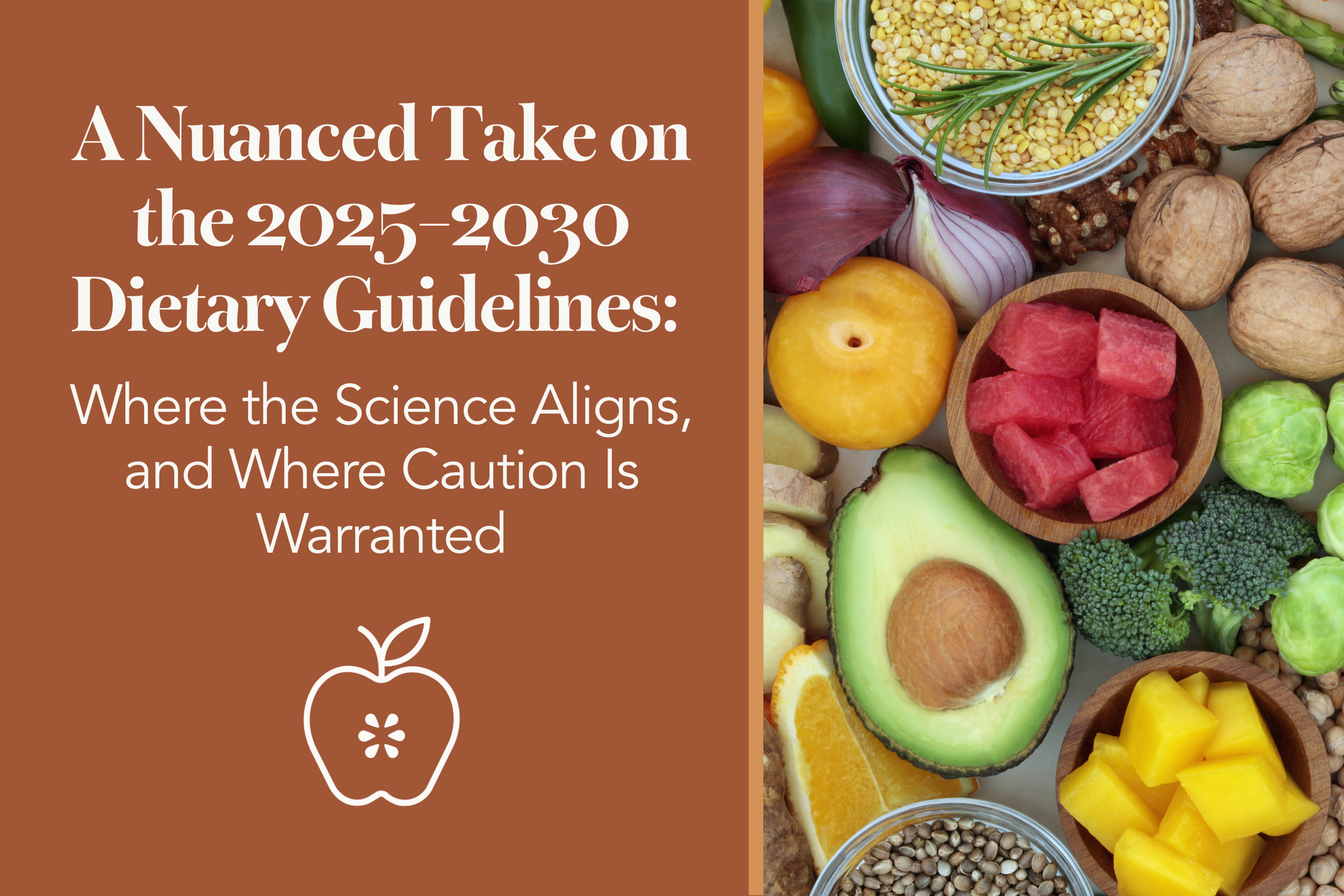
That said, there are meaningful positives in the 2025–2030 Guidelines, and also areas where the recommendations feel stronger or more absolute than the current evidence supports.
Let’s break down both.
Where the Guidelines Get It Right: A Return to Real Food
One of the most encouraging shifts in the new guidelines is the renewed emphasis on real, minimally processed foods. The call to eat more vegetables, fruits, whole grains, and nutrient-dense protein — while cutting back on ultra-processed foods, added sugars, refined carbohydrates, and sugar-sweetened beverages — is strongly supported by decades of research.
Higher intake of ultra-processed foods has been consistently linked to increased risk of obesity, cardiovascular disease, and overall mortality. In contrast, dietary patterns centered around whole foods and whole grains are associated with better cardiometabolic outcomes, improved metabolic health, and greater longevity.
These recommendations feel genuinely aligned with both the science and what most of us see play out in daily life: when people eat more real food and fewer packaged, hyper-palatable products, they tend to feel better, regulate appetite more easily, and see improvements in markers like blood sugar and cholesterol.
This foundation is solid, and worth reinforcing.
Where the Evidence Is Less Clear
Where I start to feel more cautious is when the guidelines move beyond this strong foundation into recommendations that feel more definitive than the evidence can confidently support.
Several areas stand out.
Non-Nutritive Sweeteners: A Tool, Not a Solution
The blanket discouragement of non-nutritive sweeteners goes beyond what current research can conclusively say. Much of the evidence linking these sweeteners to negative health outcomes is observational and highly context dependent.
No non-nutritive sweetener has been proven harmless long term, but that doesn’t mean they have no place at all.
From a practical standpoint, they can be a useful short-term tool for people transitioning away from high sugar intake or reducing calories to support weight loss, with the understanding that the end goal is less overall sweetness, not swapping sugar gram for gram with substitutes.
Occasional use of stevia or monk fruit may be reasonable, since they’re more naturally derived, but they still reinforce a higher sweetness threshold. From a research perspective, the safest long-term strategy isn’t replacement, it’s retraining the palate.
Alcohol: “Less” Isn’t Clear Enough
The 2025–2030 guidelines now simply suggest Americans “consume less alcohol.” While this may sound reasonable, it’s less aligned with emerging research than prior quantitative limits.
The best available evidence shows that no level of alcohol consumption has been proven risk-free, particularly when it comes to cancer risk and overall mortality. Large international health authorities, including the World Health Organization, consistently find that alcohol increases the risk of several cancers and contributes to higher all-cause death rates even at moderate levels.
Historically, clearer guidance, such as limiting intake to one drink per day for women and two for men, helped provide evidence-based guardrails to reduce risk. Removing quantitative limits may leave people without meaningful direction, especially given that alcohol’s harms begin at low levels and vary significantly between individuals.
Beyond cancer and mortality, alcohol also has significant effects on sleep, stress, and anxiety — an area that often gets overlooked.
Alcohol may feel calming at first because it boosts GABA, the brain’s main inhibitory neurotransmitter. But with repeated use, the brain adapts by down-regulating GABA and up-regulating glutamate. When alcohol wears off, this creates a rebound state of hyperexcitability, experienced as anxiety, restlessness, and irritability.
Repeated drinking also disrupts the stress response system (the HPA axis), raises baseline cortisol, and worsens sleep — all of which can amplify anxiety over time. In short, the temporary calm often comes at the cost of a more anxious nervous system.
Saturated Fats and Animal Protein: Balance Still Matters
The framing around saturated fats and animal protein in the new guidelines also raises scientific concerns.
While I fully support the move away from ultra-processed foods, explicitly naming butter and beef tallow as acceptable fat options and broadly elevating animal protein as a population-wide priority goes beyond what the strongest body of nutrition evidence supports.
The most consistent findings in nutrition science show that replacing saturated fats with unsaturated fats lowers LDL cholesterol and cardiovascular disease risk, while higher saturated fat intake reliably raises LDL — a causal risk factor for heart disease.
Similarly, long-term cohort studies consistently associate higher plant protein intake with lower cardiovascular and all-cause mortality risk, while higher intake of animal protein — particularly red and processed meats — is linked to higher cardiometabolic risk.
Emphasizing animal protein at a population level also risks displacing fiber-rich plant foods that are strongly protective for heart health, metabolic health, and longevity.
From an evidence-based perspective, the most defensible position remains unchanged:
- Limit saturated fats
- Prioritize unsaturated fats
- Center protein intake around plant sources
- Use animal foods as a complement, not the foundation
The Bottom Line
The 2025–2030 Dietary Guidelines take important steps in the right direction — especially by refocusing on whole, minimally processed foods. That foundation deserves support.
At the same time, nutrition science is complex, evolving, and rarely absolute. When recommendations move beyond what the strongest evidence can support, nuance matters.
The most reliable long-term approach remains consistent: eat mostly real food, prioritize plants, limit ultra-processed products, be cautious with alcohol, and focus on patterns, not perfection.
If there’s one takeaway, it’s this: guidelines can inform us, but they shouldn’t replace critical thinking or individualized care.
Share
The Strivewell Journal